Watch the following video all about what lives in the rainforest! While you are watching, try to remember some of the plants and animals that you see in the video.

The Rainforest
Learn about the plants and animals that live in the rainforest.
The Rainforest
Learn about the plants and animals that live in the rainforest.
Video Transcript
SciShow Kids!
Host: It's a drizzly, rainy day outside. So we thought we'd pull out a few of our books and explore some cool, colorful places where wet weather is pretty much the only weather there is. I'm talking about rainforests.
You can probably tell from the name that rainforests have a whole lot of two things: trees and rain. And sure enough, rainforests get more rain than any other place on Earth. In some areas of the rainforest, it rains every day.
And people often think that rainforests all look like this: warm and steamy with animals like colorful birds and plants like banana and mango trees. And there are lots of rainforests like that. But a rainforest can also look like this: home to animals that are adapted to cooler weather, like bears and elk.
Both of these places are rainforests, but they're found in different parts of the world. The warm rainforests are found here, close to the imaginary line that runs around the middle of the Earth. This part of the world is called the tropics. It gets lots of sun, which is why the temperature is really warm almost all of the time.
And there are a lot of different kinds of plants and animals that live in these warm rainforests. So many, in fact, that scientists talk about the rainforest as having layers that change as you go from the top to the bottom. And different animals and plants live in each layer.
For example, at the top layers of the rainforest in the tropics, all you can see is the very tippy-tops of the tallest trees. There's lots of sunlight up there that the trees use to grow, so these tall trees have lots of leaves. And these big, leafy trees make lots of shade. They block some of the sunlight from getting to the lower layers, kind of like a big green umbrella.
And all of the leaves and fruit in the top layers means that there's plenty of food for animals to eat. So many different kinds of animals live up here, like insects, parrots, bats, monkeys, and sloths. Some of these animals never even go down to the ground at all. They don't need to. Everything they need is at the top of the rainforest.
Now, the lower layers don't get as much sunlight as the top, but they're still home to plenty of living things, like snakes, lizards, and even big cats like tigers and jaguars. And just like the animals at the top of the rainforest, animals down below are perfectly suited to the place where they live.
The big cats, for example, have patterns on their coats that help them blend in with the rainforest. The jaguar has spots, and the tiger, as you all know, has stripes. And these patterns help the animals hide amongst the shadows of the trees.
Okay, but what about the cooler rainforests? They're found here, much farther away from the tropics. These rainforests are cooler because they don't get as much sun as the warmer ones. They also have layers, but the plants and animals that live there are pretty different.
The top layer of cooler rainforests, for example, is made of conifers. Those are the kinds of trees that usually have cones, like pines and redwood trees. And these kinds of trees have needles, too, like some other kinds of evergreen. These needles help the trees save energy during the cold winter.
And it's not only the plants that are different here. Animals that live in these rainforests also have to be able to live in cooler temperatures. So many of the creatures that live in the lower layers of these rainforests have coats that help keep them warm.
For example, some tigers live in these cool rainforests, and they also have striped coats that help them blend into the shadows. But their fur is nice and thick, so it keeps them warm. And other furry mammals live in these cold forests, like brown bears, black bears, and elk. Quite different from the macaws and monkeys that live in the warmer forests.
Wow, that was quite an imaginary tour! We went all over the world in just a few minutes. But now I want to find out even more about the amazing rainforests around our world. Come on, Squeaks, let's head to the library.
Thanks for joining us on SciShow Kids! Do you have a question about something or some place in the world that you'd like to learn more about? If so, ask a grown-up to help you leave a comment down below, or send us an email to kids@scishow.com. Thanks, and we'll see you next time here at the fort.
SciShow Kids!
Driving Questions
Look at the three Driving Questions below and in your groups, decide which question you would like to answer. Each group can answer the same question or each group can answer different questions. The choice is yours!
- What makes a jungle a special place to live?
- What do people need to survive in the jungle?
- How can we protect jungles and forests?
Possible Ideas
Jungle Diorama Survival Kit Save the Jungle
What makes a jungle a special place to live?
Possible Idea: Jungle Diorama
Activities:
- Students create a 3D jungle model using craft materials.
- Include plants, animals, and features like rivers or trees.
- Label the elements of their diorama and explain how they are important for life in the jungle.
- Display the dioramas in the classroom and invite members of the school and/or community to complete the walk-through of the models.
What do people need to survive in the jungle?
Possible Idea: Jungle Survival Kit
Activities:
- Brainstorm items needed to explore or survive in the jungle (e.g., water bottle, compass, mosquito net).
- Draw or make models of the items.
- Present the kit and explain why each item is important.
- Optionally, role-play being jungle explorers using their kits. A video of the kit being used can be created to share with others.
How can we protect jungles and forests?
Possible Idea: “Save the Jungle” Campaign
Activities:
- Learn about threats to jungles, like deforestation or pollution.
- Create posters, flyers, or videos encouraging others to protect forests.
- Share their campaign materials with the school or community.
- Reflect on small actions they can take to help the environment.
Thinking Time
What will your group do or make to answer your Driving Question? Use the space below to draw some ideas with your group. Remember to download or save your picture for future use!
Need To Knows
Now that you’ve chosen your question, think about your “Need To Knows.” These are the questions that you need answers to in order to help you answer your Driving Question. Follow the steps below to help you create and refine your questions.
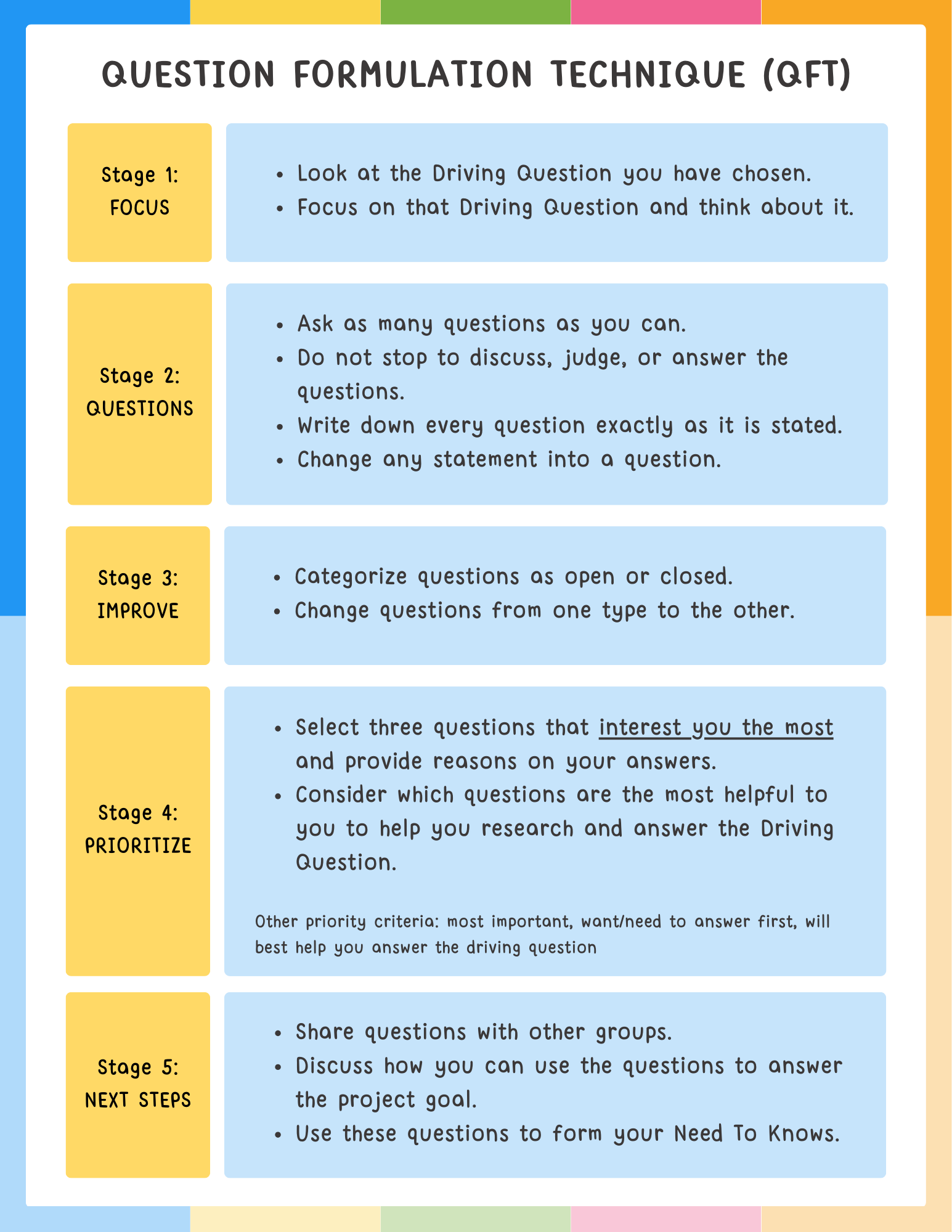
-------------------------------------------------------------------------------------------
Old Project Question
For classes using the old unit project, PBL can be integrated with the following Driving Question:
Which animal should be named, “King of the Jungle”?