Watch this video about all freshwater and why it is so important for life on Earth. While you are watching, make a list of all the numbers you hear mentioned when they’re talking about water.

Water Basics
Learn about freshwater and why it is so important for life on Earth.
Water Basics
Learn about freshwater and why it is so important for life on Earth.
Video Transcript
Voices: Science. Crash Course Kids.
Sabrina: Let me take you back in time for a sec. Way back to the beginning of this show. Remember that? The very first thing we learned is that animals need the energy from food in order to live. And that's still true. But I've news for ya. There's something else that animals and pretty much everything else need to live, too. No, not YouTube videos of cats, although it's hard to imagine life without them. I'm talking about water.
Living things need water. Some living things need freshwater, and some need saltwater, but all living things need some form of water to keep on living. I know you know what water is. You've seen it, you've done cannonballs into it, you've filled balloons with it and thrown them at people. And you certainly drink it.
Water is one of the most common substances on Earth. It covers more than two-thirds of the surface of our planet. We actually have enough water on Earth to leave a faucet running for 136 trillion years. But let's not do that. Because for all the water we have, there's one kind of water that we need to keep us alive. And that's freshwater.
So what is freshwater, and where do we get it? Big question.
Well, it's probably easier to start with where it's not. Most of the water on Earth is in the oceans. They're huge, and they're also full of salt. So most of the water on Earth is actually saltwater. By contrast, freshwater is found in lakes, rivers, ponds, wetlands, and streams, and it contains very little salt. Less than 0.1% salt, actually.
And plants and animals, including us humans, depend on freshwater because we can't survive on saltwater. The amount of salt in saltwater is much higher than what our bodies can process. In fact, drinking too much saltwater could even kill a person, which is just one of the reasons freshwater is so important.
So now you know what freshwater is and that it's super necessary to our survival. But if the oceans make up most of the water on Earth, where can you find freshwater? Let's take a look at a map to see if we can find some of its major sources. Investigation.
People who study geography, we call them geographers, use maps all the time. They're interested in Earth's physical features like its mountains, deserts, rivers, and oceans. This map shows all of the Earth's land and water. All of the blue stuff is water. But remember, most of the blue stuff is saltwater. In fact, about 97% of the water on the planet is salty.
So let's do some math with that. If 97% of the Earth's water is saltwater, then only about 3% of the planet's total water supply is freshwater. But about 2% is locked up in frozen glaciers or underground where we can't get to it. So that means of all the water that's on Earth, less than 1% of it is actually accessible to us on the surface so we can grow crops and have drinking and bathing water for our homes.
Now that you know how little freshwater there really is on Earth's surface, it kind of makes sense that most sources of freshwater would be too small to spot on a map this big. But if we zoom in, we can get close enough that we can spot a few. See any freshwater sources here in North America? I'll give you a hint: they're pretty great.
I'm talking about the Great Lakes. The Great Lakes hold a lot of freshwater. About 20% of Earth's available freshwater is actually in those five lakes. But the Great Lakes are really big examples of where freshwater can be found. Most freshwater is in much smaller lakes, rivers, and streams on every continent. Those are the small blue lines and the inland bodies of water like these.
So what does this map tell us? Conclusion.
Well, it tells us that there's a lot of water on Earth, but very little of it is freshwater. And since humans and many other animals need freshwater to survive, they're likely to live in habitats that are near major sources of freshwater, like a river or a lake. Maybe one of the Great Lakes.
If they don't live near a source of freshwater, then people have to adapt their environment to bring the water to them. Remember when we talked about Las Vegas? So freshwater is the substance that keeps you and me and Catbot and Grumpy Cat and just about every other living thing alive. And it's all over the Earth in extremely limited amounts. So use it wisely.
Driving Questions
Look at the three Driving Questions below and in your groups, decide which question you would like to answer. Each group can answer the same question or each group can answer different questions. The choice is yours!
- How can we show others what life in water is like?
- How can we help keep the water in our communities clean for every living thing?
- How can we create safe ways to play in water?
Possible Ideas
Water Display Save Our Water Water Day
How can we show others what life in water is like?
Possible Idea: Interactive Water Display
Activities:
- Students choose which water ecosystem they wish to explore.
- Students research the forms of life and life cycles in this watery ecosystem.
- Create an interactive display showing what life in waterways is like.
How can we help keep the water in our communities clean for every living thing?
Possible Idea: Save Our Water
Activities:
- Students research ways to keep community water clean.
- Students create artifacts to show these tips (brochure, movie, etc.).
- Students call the community to help implement these tips.
How can we create safe ways to play in water?
Possible Idea: Water Day
Activities:
- Students find different ways to play safely in water and create documents or experiences to showcase these activities.
- Host a “Water Day” in the community to share these activities with others.
- Students may wish to create Water Fun Kits to distribute at this event, too.
Thinking Time
What will your group do or make to answer your Driving Question? Use the space below to draw some ideas with your group. Remember to download or save your picture for future use!
Need To Knows
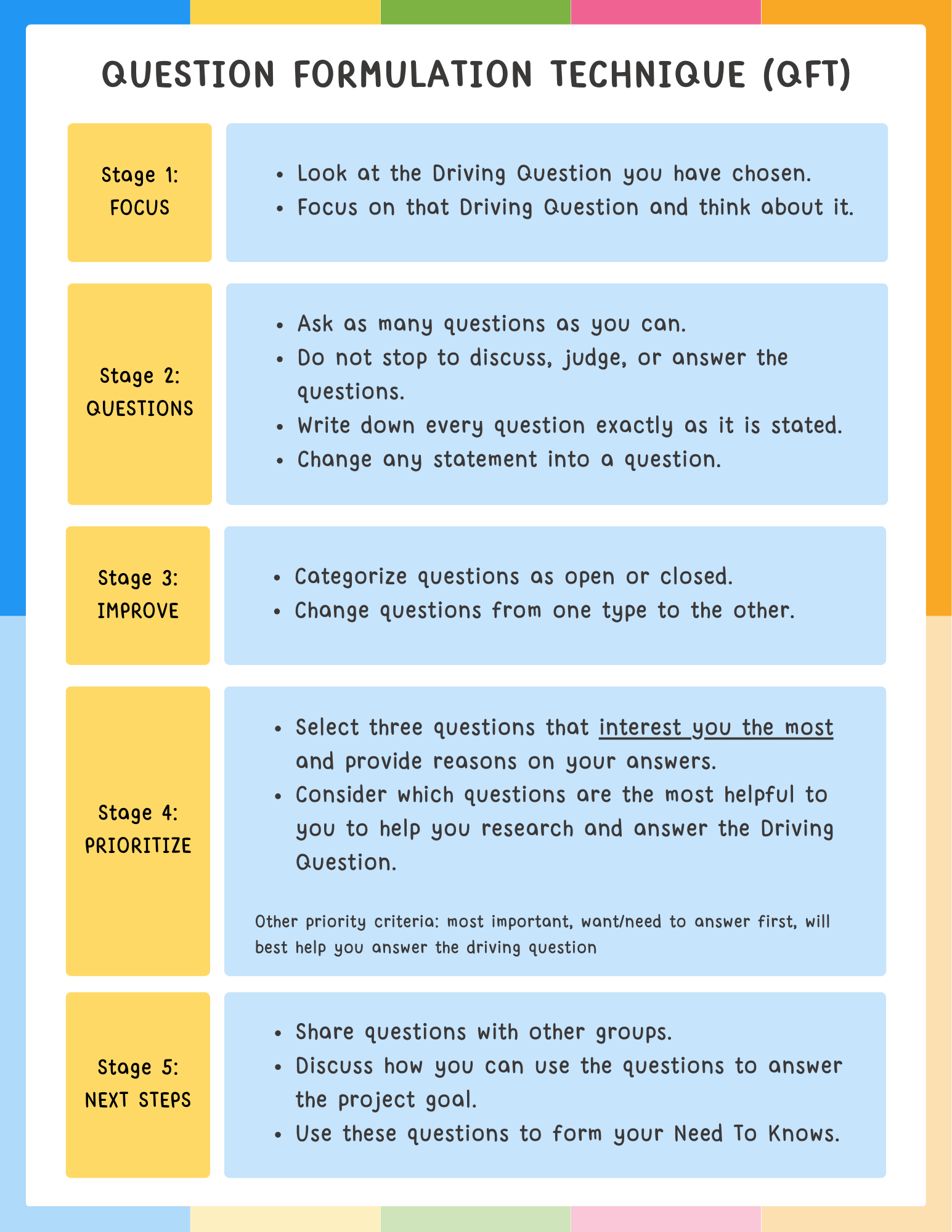
Now that you’ve chosen your question, think about your “Need To Knows.” These are the questions that you need answers to in order to help you answer your Driving Question. Follow the steps below to help you create and refine your questions.