Watch the following video all about what lives in a desert! While you are watching, try to remember some of the plants and animals that you see in the video.

Deserts
Learn about the plants and animals that live in deserts.
Deserts
Learn about the plants and animals that live in deserts.
Video Transcript
Hello friends! Welcome to a new Happy Learning video. Take a look at these images. Today we're going to see a place where it's both really hot and very very cold. and where it hardly ever rains do you know which place it is it's the desert deserts are arid places where there often appears to be no life yet they are home to amazing plants and animals which have had to develop incredible abilities in order to survive But what makes a place a desert? It's not the sand, no, nor is it the heat. It's actually the scarcity of a fundamental liquid, water. If a place receives an average of 25 centimetres of rainfall per year, which is very, very little, then we say that that place is a desert.
Deserts cover one fifth of our planet. The most important are the Sahara Desert, the Arabian Desert, the Australian Desert, the Gobi Desert and the Atacama Desert. But there are also two very special deserts because they are frozen. The Arctic and the Antarctic deserts. The world's largest hot desert is the famous Sahara Desert. Here, the temperatures can reach 57 degrees Celsius during the day.
Now that's hot. But at night, they can drop to 10 degrees below zero. Freezing! This huge temperature change occurs because it's so dry that the clouds can't even form. And the clouds not only produce rain, but also act as a shield. They protect us from the heat of the sun's rays. And at night, they prevent heat from escaping.
The few plants in the desert are very special because they have had to adapt to the lack of water in order to live. Some store all the water they get in their stems, like these cacti. Others extend roots for many, many meters until they find some moisture. Some remain in a dormant state as if they were asleep and when a few raindrops fall they turn the desert into a garden.
How beautiful! Although the truth is they don't last very long. The animals that live in the desert are also very interesting. Look at these camels. Their humps are full of fat. They are like a reservoir of moisture and so they can go for up to 10 days without drinking.
Other animals like this lizard or this snake prefer to hide during the day and come out at night to hunt.
Deserts are also home to people like nomadic tribes that never stop travelling from one place to another. Their clothes protect them from the heat and frequent sandstorms. What a hard life! As we said at the beginning, there are frozen deserts. They are in the polar areas of the Arctic and Antarctica. They are huge expanses of ice where it hardly rains and where it's very cold.
Moreover, did you know that for many months of the year, in frozen deserts, there is almost no light? Most plants cannot photosynthesize. That's why there are only mosses and lichens. The animals that live in frozen deserts have thick layers of fat and lots of fur or feathers to withstand the cold like these polar bears, this arctic fox.
these penguins. Did you know that deserts are growing? Look at these pictures. Deforestation, fires and water pollution are turning places full of life into dry and barren land where nothing grows anymore, where it's very difficult for life to prosper. That's why Happy Learning is asking you to take care of the environment. Don't waste water and recycle as much as you can to avoid pollution.
All together, we can make sure that deserts do not advance one more centimeter. If we do this, our planet and all living things will thank us. Goodbye friends, see you in the next video.
Driving Questions
Look at the three Driving Questions below and in your groups, decide which question you would like to answer. Each group can answer the same question or each group can answer different questions. The choice is yours!
- How can we teach others about deserts?
- How can we show others how desert animals survive in such harsh conditions?
- How can we create a model that shows the unique features of a desert?
Possible Ideas
Desert Museum Puppet Show Desert Diorama
How can we teach others about deserts?
Possible Idea: Desert Discovery Museum
Activities:
Create artifacts for a classroom “Desert Museum,” including:
- Mini-dioramas
- Drawings of desert landscapes
- Posters with facts about desert plants, animals, and climate
Students then act as tour guides, explaining their displays to visitors (e.g., other students, parents). Students experience working in groups and being hosts for functions.
How can we show others how desert animals survive in such harsh conditions?
Possible Idea: Desert Puppet Show
Activities:
- Students pick a desert animal to research (e.g., camel, lizard, scorpion).
- Create puppets using paper bags, socks, or craft materials.
- Write a short script where animals talk about how they adapt to the desert environment.
- Perform the puppet show for classmates or another grade.
How can we create a model that shows the unique features of a desert?
Possible Idea: Desert Diorama
Activities:
- Build a desert diorama in a shoebox, including plants, animals, and landscape features.
- Use craft supplies (sand, clay, paper, and small figures) to make it realistic.
- Label key elements like cacti, sand dunes, and desert animals.
- Present the dioramas to classmates or parents, explaining what they included and why.
Thinking Time
What will your group do or make to answer your Driving Question? Use the space below to draw some ideas with your group. Remember to download or save your picture for future use!
Need To Knows
Now that you’ve chosen your question, think about your “Need To Knows.” These are the questions that you need answers to in order to help you answer your Driving Question. Follow the steps below to help you create and refine your questions.
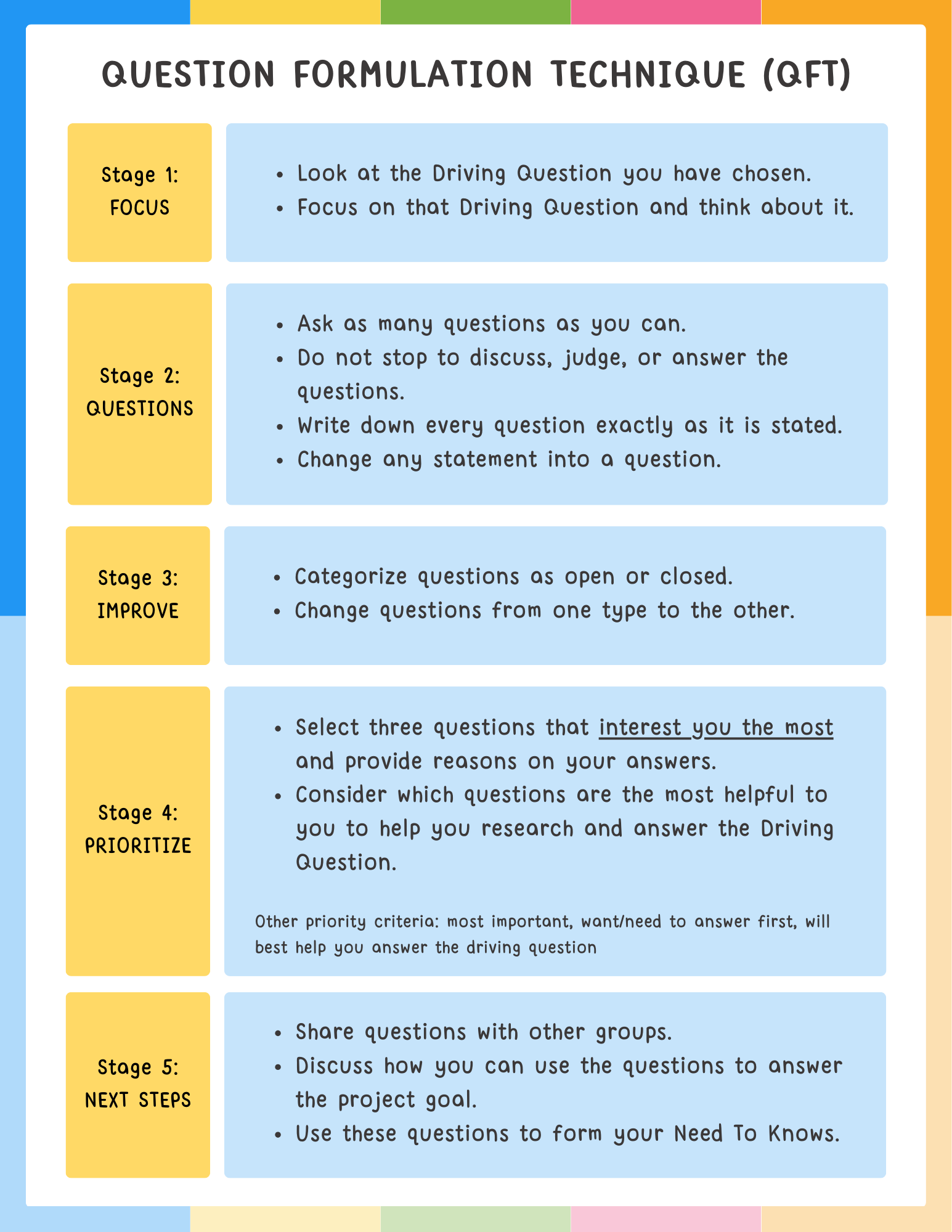
-------------------------------------------------------------------------------------------
Old Project Question
For classes using the old unit project, PBL can be integrated with the following Driving Question:
How can we change our bodies to be able to survive in a desert environment?