Watch this insightful video showing the creative side of ancient Greece. While you are watching, list all the creative ways the ancient Greeks enjoyed life.

Music & Creativity In Ancient Greece
Discover the creative side of ancient Greece — music, art, and play.
Music & Creativity In Ancient Greece
Discover the creative side of ancient Greece — music, art, and play.
Video Transcript
Music We live in a society obsessed with music. We use music to worship, tell stories, to celebrate, to work, exercise, declare our love and sometimes our hatred, and arguably, most importantly, to dance. And of course we play music ourselves because, well, it's a pleasant thing to do. thousands of years ago in ancient Greece when it came to music things weren't much different they might have had lyres and tunics instead of mp3 players and jeans but the ancient Greeks were just as obsessed with music as we are today in fact music was such an important part of ancient Greek society that it makes us seem tame by comparison to really understand just how integral music was to the ancient Greeks let's begin by acquainting ourselves with a bit of their mythology In ancient Greek mythology, it was believed that human creativity was the result of divine inspiration from a group of goddesses known as the muses.
While scholars have argued over the years that there are anything between 3 and 13 muses, the standard number accepted today is 9. Each muse oversees her own specific area of artistic expertise, ranging from song and dance to history and astronomy. It might seem strange to categorise history and astronomy as creative pursuits, but the ancient Greeks saw these disciplines as more than just school subjects.
These were the hallmarks of civilisation in what, to their eyes, was a pretty barbaric world. An educated, civilised person was expected to be proficient in all aspects of creative thought inspired by the muses, and the common medium through which these disciplines were taught, studied and disseminated was music. You see, it's no coincidence that the word muse is very similar to the word music.
It's where the word originates. Poetry, be it a love poem or an epic poem about a dragon-slaying hero, was sung with a musical accompaniment. Dancing and singing, obviously, were accompanied by music. Theatre was always a combination of spoken word and music. History was recounted through song. Even the study of astronomy was linked to the same physical principles as musical harmony, such as the belief held by many Greek thinkers that each of the planets and stars created their own unique sound as they travelled through the cosmos, thrumming like an enormous guitar string light years long.
However, music pervaded more aspects of their lives than just education. Ancient Greeks considered music to be the basis for understanding the fundamental interconnectedness of all things in the universe. This concept of connectivity is known as harmonia, and it's where we get the word harmony.
Music was used as a form of medicine to treat illnesses and physical complaints, as a vital accompaniment to sporting contests, and as a means to keep workers in time as they toiled away on monotonous or menial tasks.
One of the most important applications of music in ancient Greek society is found in the belief that music can affect a person's ethos. A word we still use today, ethos is a person's guiding beliefs or personal ethics, the way that one behaves towards oneself and others. The Greek philosopher Plato, one of the most famous and influential Greek thinkers at the time, asserted that music had a direct effect on a person's ethos.
Certain kinds of music could incite a person to violence, while others could placate a person into a benign, unthinking stupor. According to Plato, only very specific types of music were beneficial to a person's ethos.
One should only listen to music that promotes intelligence, self-discipline and courage, and all other kinds of music must be avoided.
Furthermore, Plato fervently denounced any music that deviated from established musical conventions, fearing that doing so would lead to the degradation of the standards of civilisation, the corruption of youth, and eventually, complete and utter anarchy. While Plato's fears can seem extreme, this argument has appeared in modern times to contend musical trends such as jazz or punk or rap.
What do you think Plato would say about the music you listen to? Is it beneficial to your ethos? Or will it degenerate you into a gibbering amoral barbarian?
Driving Questions
Look at the three Driving Questions below and in your groups, decide which question you would like to answer. Each group can answer the same question or each group can answer different questions. The choice is yours!
- How can we host our own Olympics?
- How can we teach the Greek alphabet to others?
- How can we show others what ancient Greece looked like?
Possible Ideas
Mini Olympics Greek Alphabet Greece Diorama
How can we host our own Olympics?
Possible Idea: Mini Olympics
Activities:
- Students investigate the types of games or sports that are included in the Olympics, including those that are no longer included.
- Students design a mini Olympics day and design the activities, some training tips, and any equipment that will be needed for this event.
- Students invite the wider community to participate in this event.
How can we teach the Greek alphabet to others?
Possible Idea: Greek Alphabet
Activities:
- Students learn all they can about the Greek alphabet and how it compares to the languages they know.
- Students create learning materials to help others learn the Greek alphabet.
- Students launch Greek alphabet lessons for fellow students.
How can we show others what ancient Greece looked like?
Possible Idea: Greece Diorama
Activities:
- Students research what ancient Greece looked like and decide on how to show this to others.
- Students create their diorama or other visual representations of this time period to share with others.
- Students invite the public to come and view their dioramas.
- Students will give a guided tour or presentation about their artifact.
Thinking Time
What will your group do or make to answer your Driving Question? Use the space below to draw some ideas with your group. Remember to download or save your picture for future use!
Need To Knows
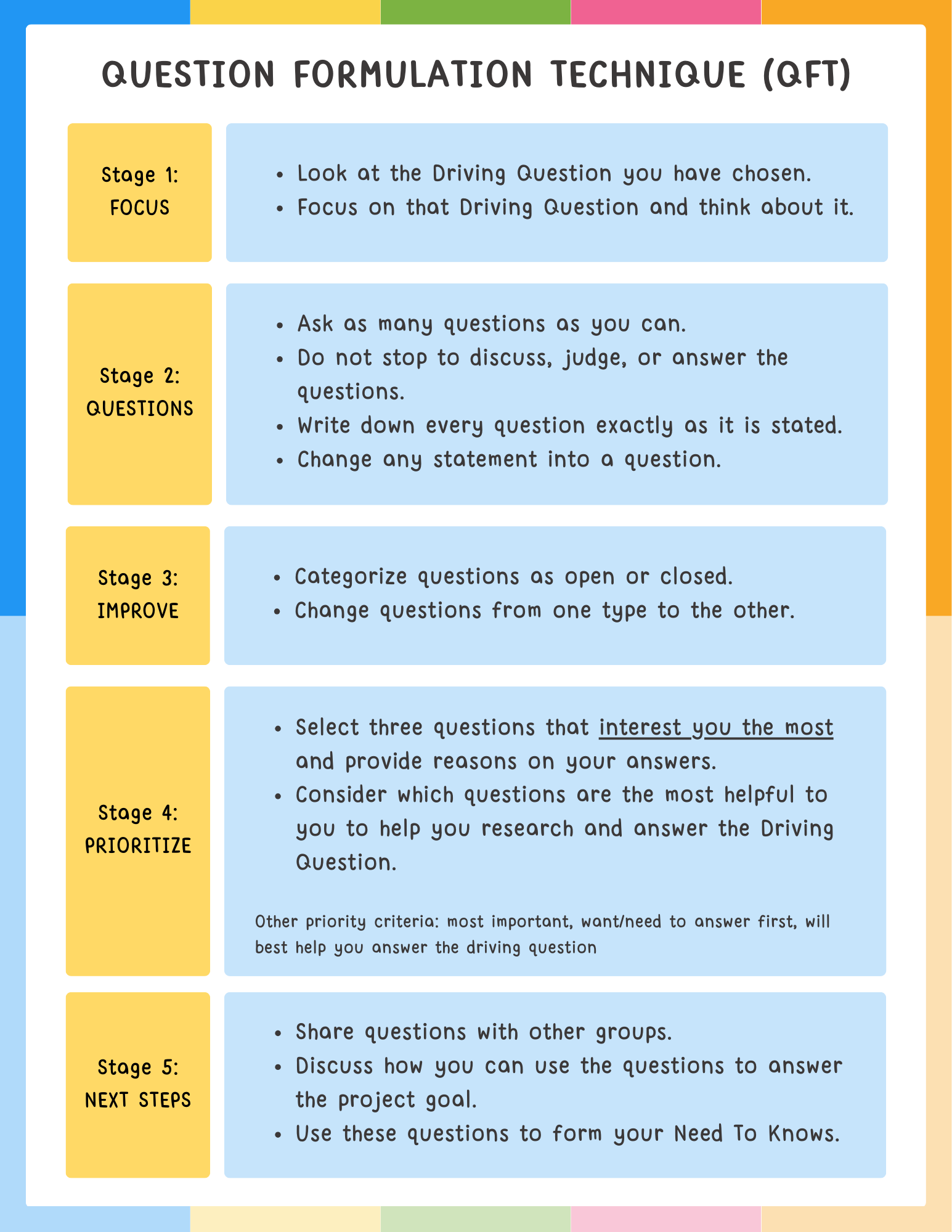
Now that you’ve chosen your question, think about your “Need To Knows.” These are the questions that you need answers to in order to help you answer your Driving Question. Follow the steps below to help you create and refine your questions.