Watch this video giving a recap of how the Ocean Cleanup project is succeeding. While you are watching, listen for all the numbers related to this project and ways we can do better.

The Ocean Cleanup Recap
A recap of how the Ocean Cleanup project is succeeding against ocean plastic.
The Ocean Cleanup Recap
A recap of how the Ocean Cleanup project is succeeding against ocean plastic.
Video Transcript
Woman: You know what? Let's do this the usual way.
Narrator: At The Ocean Cleanup, 2025 has been defined by record-breaking catch numbers, a continued commitment to efficiency, and, yeah, some AI.
Our team has spent 2025 hard at work identifying opportunities for increased efficiency in our cleanup systems. We spent time in the labs, the air, rivers, and the Great Pacific Garbage Patch itself, collecting data and improving our understanding of plastic pollution and the most efficient ways to remove it from our aquatic environments.
This year, we developed new technologies and tools that can help support our mission. One highlight is ADIS, our Automated Debris Imaging System, which identifies and maps ocean plastic. ADIS plays a massive role in expanding our plastic tracking database.
We also introduced the Smart River Survey, a tool that breaks down complex data layers to create a clear action plan for large-scale river cleanups. The survey will be integral to the 30 Cities Program that we launched this year at the United Nations Ocean Conference in Nice.
This program tackles some of the most polluted bodies of water in the world, aiming to stop up to a third of all plastic pollution entering the ocean from rivers by 2030.
We have also introduced coastal sweeps. Only after our interceptors are in place and performing efficiently, we identify plastic hotspots where we remove legacy plastic trapped in nearshore environments like beaches, mangroves, and coral reefs. These coastal sweeps help local communities reclaim their environment and help ecosystems to recover.
But wait, there's more. Our scientific data was used to inform upstream policy decisions at international conferences like the Global Plastics Treaty. It's great to support this growing interest for better regulations around plastic and discarded fishing gear. And while policy catches up, we continue to set the pace.
We deployed new interceptors in Panama and Honduras, improved efficiency in Cisadane and Klang, and started preparations for new deployments in Manila and Mumbai. Our interceptors in Jamaica and Los Angeles had record catches, and we set two back-to-back records.
First, the most trash intercepted in a year: more than 25 million kilos. To give you an idea, that is the equivalent of over 200 million Labubus. And second, an overall catch of 45 million kilos, representing both trash removed from the ocean and pollution that would have otherwise entered into it.
And beyond these impressive numbers, what truly matters is the lasting impact our efforts have on the environment and on the people who directly benefit from healthier rivers and coastlines.
Of course, this couldn't have been done without you, our amazing supporters, who are actively helping us make the ocean a cleaner place. And as we sail into 2026, we look forward to what we can achieve together.
Driving Questions
Look at the three Driving Questions below and in your groups, decide which question you would like to answer. Each group can answer the same question or each group can answer different questions. The choice is yours!
- How can we help our community to be greener?
- What can we do to stop litterbugs?
- How can we help others live by The Three R’s?
Possible Ideas
Green City Anti-Littering Three R’s
How can we help our community to be greener?
Possible Idea: Green City
Activities:
- Students research ways that their community could be greener.
- Students put forth a proposal (presentation, poster, movie, etc.) to the community to gather support and help.
- The students/school become community leaders in initiating and continuing the project.
What can we do to stop litterbugs?
Possible Idea: Anti-Littering Campaign
Activities:
- Students research littering statistics, their causes, and potential tools to stop litterbugs.
- Students design a campaign to highlight this issue in their community.
- Students showcase or display their artifacts in a community-wide anti-littering campaign.
How can we help others live by The Three R’s?
Possible Idea: The Three R’s
Activities:
- Students find ways that The Three R’s can be integrated into everyday life.
- Students create posters or other artifacts to showcase these ideas.
- The community is shown these ideas via an open day, a social media campaign, or other measure.
Thinking Time
What will your group do or make to answer your Driving Question? Use the space below to draw some ideas with your group. Remember to download or save your picture for future use!
Need To Knows
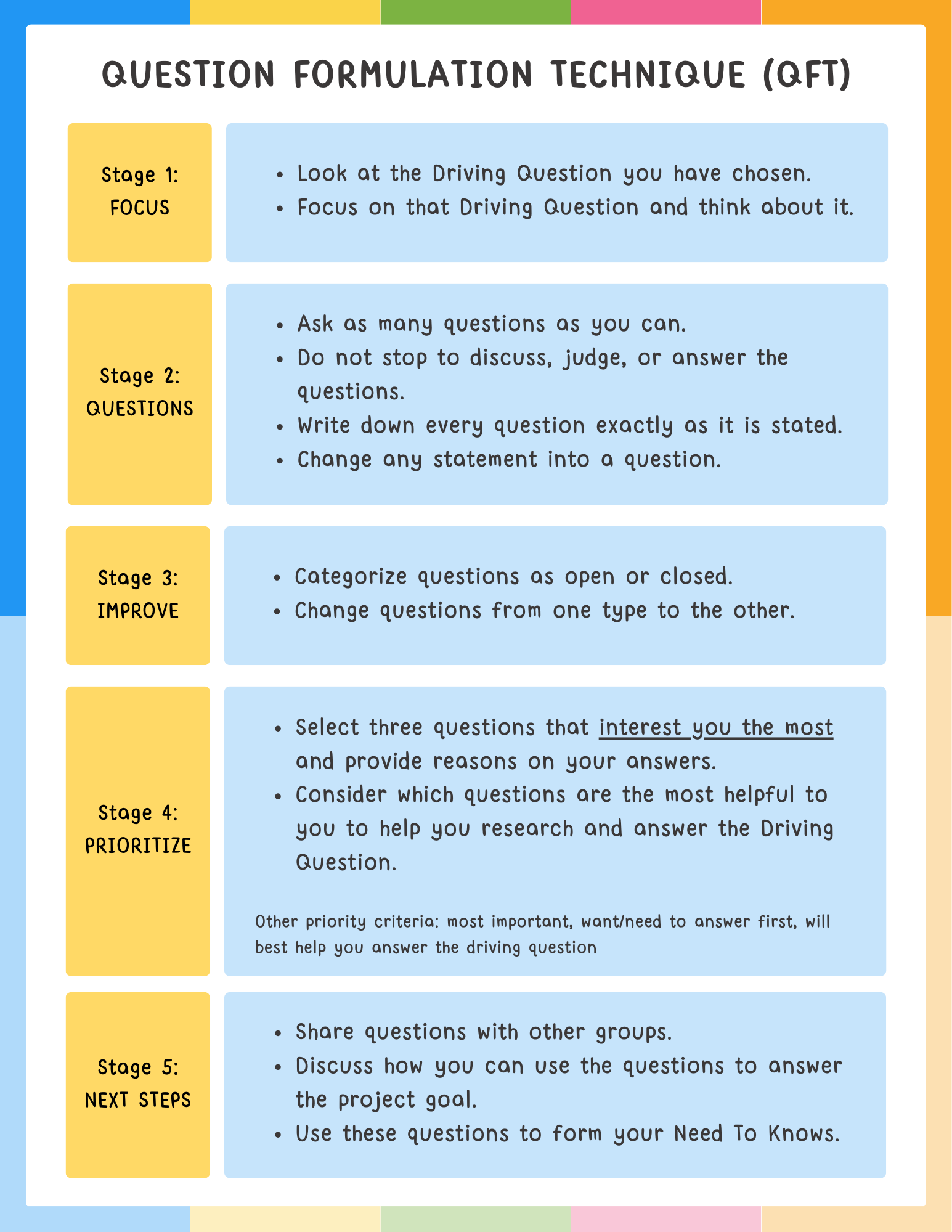
Now that you’ve chosen your question, think about your “Need To Knows.” These are the questions that you need answers to in order to help you answer your Driving Question. Follow the steps below to help you create and refine your questions.