Watch this video about a teacher who takes her students on a journey every year to write a novel in 30 days. While you are watching, listen to her encouraging words and how the teacher overcame her students’ fears.

Writing A Novel In 30 Days
A teacher takes her students on a journey to write a novel in 30 days.
Writing A Novel In 30 Days
A teacher takes her students on a journey to write a novel in 30 days.
Video Transcript
Laura Bradley: Good morning!
Every year when I present this challenge, I wonder, will this be the year that students will say no I can't do this? Yet every year, I see those kids have a story to tell.
So, planners out, and notebooks, and pen or pencil.
When I look back on my own learning about reading and writing, there was not a lot of writing that I felt ownership over. I've always been most comfortable with writing expository, non-fiction, and when I heard about NaNoWriMo, I thought eighth graders writing a novel, that's impossible, and I couldn't even imagine writing a novel.
You guys are ready for the 30-day challenge, you are...
As far as projects go, this one is big. NaNoWriMo stands for National Novel Writing Month, and it's a challenge for young writers to write a novel in the 30 days of November.
You'll start brainstorming what settings are going to be part of your story.
A lot of them say, I can't do this. I'm afraid, I don't want to do it. The counselors say that kids will show up at their office saying please move me out of Mrs. Bradley's class. Does she know I'm only 13?
So one of the first challenges was my own fear that they would not have stories to tell.
Girl: Okay, what's your setting?
Laura Bradley: When I had them brainstorm their stories, and then we all sat in a circle and I had them share out, one after another I was blown away at the creativity and the passion, the voices that they had that they needed to share.
Girl: The opening scene of my novel be a flashback to my main character's grandfather in the prisoner of war camp.
Boy: He's eating takeout Chinese with his mom, who just got out of open heart surgery.
Girl: And from up above Leo looked down, young Leo. He looked down and smiled. He smiled for Leo for moving on, for saving the universe. Well, the two of them.
Laura Bradley: That's amazing.
These students speak with such authority. They know what the characters are going to do, they know where the plot is going, they know the conflicts that have to be worked through, and they know how it all will end.
I'm peeking over your shoulders and it's just amazing. I'm so impressed.
I remember as a student being pretty excited to take my writing and staple it into a pretty construction paper cover, and that was publishing. But my students now are able to send the Amazon link to their relatives and share their novel with the world.
I hope that they recognize that what used to seem impossible really is possible for them, and that they leave my class going on to high school identifying as a writer. That when a teacher asks them to write something, they in their mind will say I can do this, because I've written a novel.
Driving Questions
Look at the three Driving Questions below and in your groups, decide which question you would like to answer. Each group can answer the same question or each group can answer different questions. The choice is yours!
- How can we help younger students improve and maintain their reading skills?
- How can we use comics to tell the story of a unique life?
- How can we create stories that our kindergarten self would have enjoyed?
Possible Ideas
Reading Pals Life Comic Kids’ Books
How can we help younger students improve and maintain their reading skills?
Possible Idea: Reading Pals
Activities:
- Students research how to help younger students with reading.
- Students create a training process for helping young readers improve and maintain their reading skills.
- Students create a Reading Pals group that pairs an older student with a younger student to help with reading.
- Students work with the younger learners and, if possible, host a Reading Day to show how well the younger students are reading.
How can we use comics to tell the story of a unique life?
Possible Idea: A Day In the Life Comic
Activities:
- Students research the life of someone famous to the community or someone from the community.
- Students decide how best to retell this story through a comic book format.
- Students create their comic and share it as a physical and/or online version.
- Students invite the subject of their comic to come and talk to others about their life and to show the comic.
How can we create stories that our kindergarten self would have enjoyed?
Possible Idea: Kids’ Books
Activities:
- Students research the typical ideas behind kids’ books and decide on which elements they wish to use.
- Students storyboard their ideas and work on creating their story.
- Students create their own book for kids and self-publish their product to be shared with younger learners in their school.
Thinking Time
What will your group do or make to answer your Driving Question? Use the space below to draw some ideas with your group. Remember to download or save your picture for future use!
Need To Knows
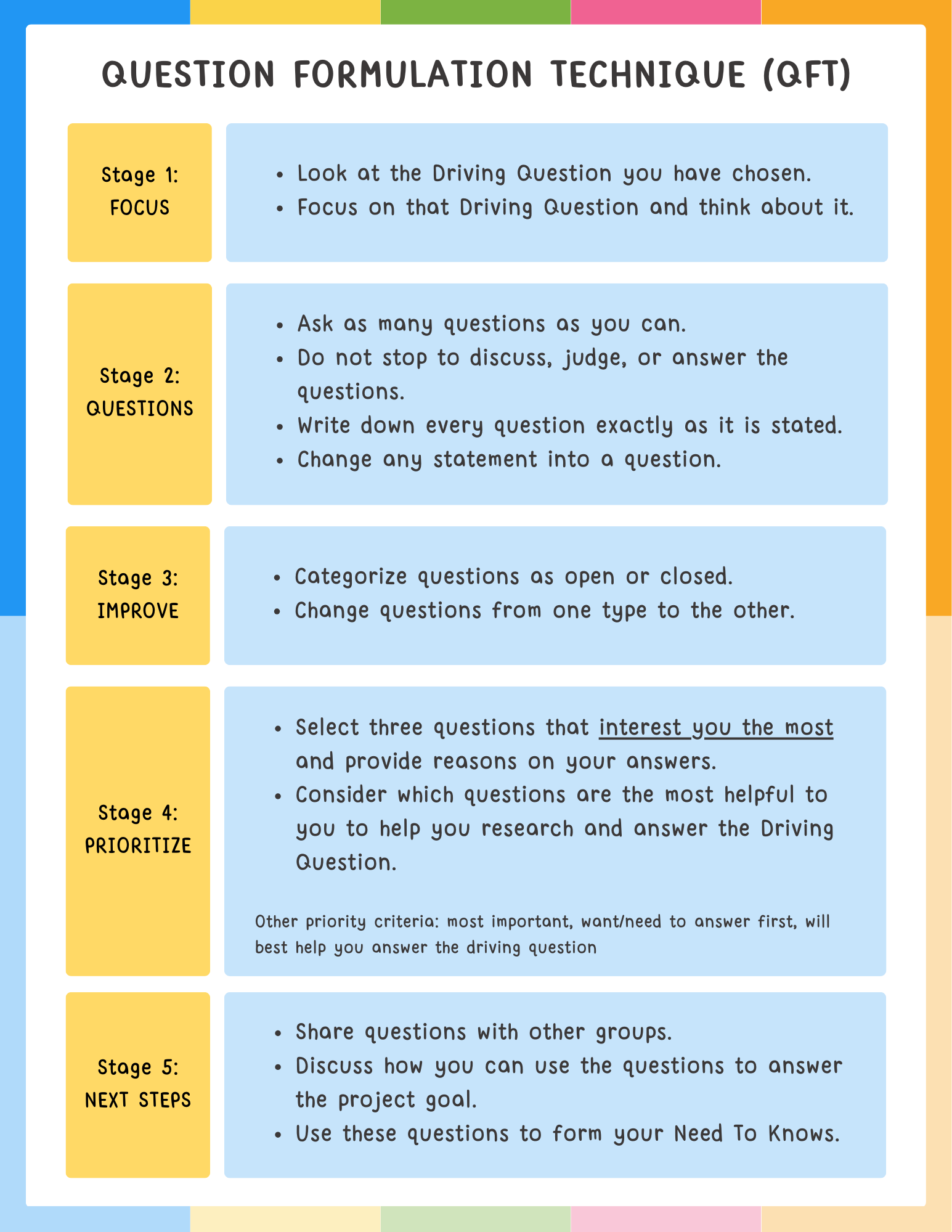
Now that you’ve chosen your question, think about your “Need To Knows.” These are the questions that you need answers to in order to help you answer your Driving Question. Follow the steps below to help you create and refine your questions.