Watch this video showcasing some green and unique schools from around the world. While you are watching, make notes about the aspects of the schools that you would like to see in your own school.

Green Schools Around The World
Take a tour of unique green schools from around the world.
Green Schools Around The World
Take a tour of unique green schools from around the world.
Video Transcript
Male Narrator: This video is sponsored by the Nick Maughan Foundation.
It's often said that children are the future and that education is the foundation of a society. But over time, school curricula have continually changed, giving every generation a new set of knowledge, skills, and values which they use to guide their lives.
Today, with climate change, deforestation, and pollution leading the pack of issues that future generations have to face, schools and universities have an obligation to lead by example and to educate and empower their students to take direct action in their own lives for the greater good.
Female Narrator: In this video, we're going to be providing three examples of how schools around the world have adapted their infrastructure, curriculum, and mission to guiding their students toward having a greener education and living a more sustainable life.
Male Narrator: Opened in 2008 with only 90 students and located amongst the rice paddies and three volcanoes of Bali, the Green School has served as a pioneer in educating children on the importance of sustainability.
First imagined by John and Cynthia Hardy in 2006, the school offers children the opportunity to learn from the natural environment around them, eating food that they have grown themselves, learning within the domes of the world's largest bamboo structure, and being encouraged to physically interact with the land and the community around them.
Female Narrator: Located about half an hour outside Ubud, the Green School emphasizes the principles of mindfulness and permaculture to encourage children toward creativity and entrepreneurship.
Each week, students have a day out away from the school with their class to travel around Bali and implement or come up with their own initiatives that can range from community recycling programs to waste management solutions.
Similarly, each day at 2:00 PM, teachers and students alike stop whatever they are doing and remain silent for one minute. This encourages teachers and students of all ages to have a moment of silence and introspection, essential to healthy development.
Male Narrator: The physical buildings themselves, all made of bamboo, aim to be completely off-grid in regards to energy and water consumption.
Energy use within the buildings is low to begin with, but about 30% of the remaining energy that the building does use comes from on-site solar panels.
Female Narrator: Similarly, the school's water consumption stays quite low, with composting toilets and uses only that which comes from a single underground well discovered during construction.
Students are also taught about their individual impact on the environment and plant bamboo shoots to offset their carbon footprint.
Male Narrator: In Copenhagen, the International School has been designed so that children can learn from the building itself.
The building's block shape was inspired by the nearby shipping containers, and the solar panels have been purposefully angled to mimic a water reflection from the sea.
The 25,000 square meter school building is Copenhagen's largest school, accommodating 1,200 students and 280 employees.
Female Narrator: It is covered in 12,000 solar panels which supply more than half of the school's annual energy needs, and which the students monitor and learn about in their maths and physics lessons.
Across the world, efforts are being made to make solar panels appear less like obtrusive add-ons and more like attractive aspects of the building. For example, Elon Musk's efforts in creating subtle solar roof tiles.
At Copenhagen's International School, the panels are not just a value-added feature, but are the star attraction.
Female Narrator: Located on the island of Oahu, Hawaii, Punahou School has been forming its students into socially responsible, ethically aware, and engaged citizens for over 180 years.
The school, educating children from ages of 4 to 18, sits on 76 acres of lush Hawaiian land, heavily influencing the construction and curriculum of the school.
Over the last two decades, Punahou has taken and continues to take extensive steps to keep in mind water and energy consumption, food and resource waste, natural lighting use, and air quality so as to not impact the surrounding area with its day-to-day operations, and aims to be net-zero by 2025.
Male Narrator: Alongside the buildings being constructed with sustainability and the surrounding environment in mind, Punahou makes sure that its positive impact on the earth extends beyond the classroom.
Green waste recycling is one such step towards having a closed-loop waste system, where the groundskeepers at Punahou turn green waste like grass clippings, leaves, and tree branches into compost, or are even converted into electricity off-campus at H-POWER, a waste-to-electricity facility on Oahu.
Female Narrator: Other initiatives that have been tied into the school's curriculum include educating students on the importance of recycling and conserving water, reducing food waste and carbon-emitting transportation use, recycling and reducing paper waste, and energy conservation.
Male Narrator: Teaching children from a young age that sustainability is normal is incredibly important for the future of our planet. We desperately need more schools to adopt these eco-friendly ways of teaching.
Female Narrator: Budgets may not always allow for schools to adapt their infrastructure entirely, however, incorporating sustainable education into the curriculum is not an expensive or difficult adaptation.
In order to do this, we must encourage school boards and governments to make environmental education an integral part of our children's learning experience.
Male Narrator: Thank you for watching this episode. Please hit the like button if you enjoyed this video, and we'll see you in the next one.
Driving Questions
Look at the three Driving Questions below and in your groups, decide which question you would like to answer. Each group can answer the same question or each group can answer different questions. The choice is yours!
- How can we make online learning fun and interesting for young kids?
- What can we change about our school to make it better for all learners?
- How can we create tools that will assist different types of learners?
Possible Ideas
Online School Dream School Learners’ Aids
How can we make online learning fun and interesting for young kids?
Possible Idea: Online School
Activities:
- Research the best tools and tips for learning online.
- Students create tools to help others with keeping online learning interesting.
- Students share their ideas with teachers and learners.
- Students host an online Class Day letting everyone experience an online lesson with the tips and tools they’ve created.
What can we change about our school to make it better for all learners?
Possible Idea: Dream School
Activities:
- Survey the students to find what may be missing from the school.
- Create a proposal for upgrades that will be viewed by the heads of the school.
- Students create mockups of the proposed upgrades to show to decision makers.
- Students can also brainstorm ways to pay for the upgrades.
How can we create tools that will assist different types of learners?
Possible Idea: Learners’ Aids
Activities:
- Research the different ways that people learn and how we can assist them.
- Students design and test different aids.
- Students create a toolkit that can be used by teachers and learners to help them learn.
Thinking Time
What will your group do or make to answer your Driving Question? Use the space below to draw some ideas with your group. Remember to download or save your picture for future use!
Need To Knows
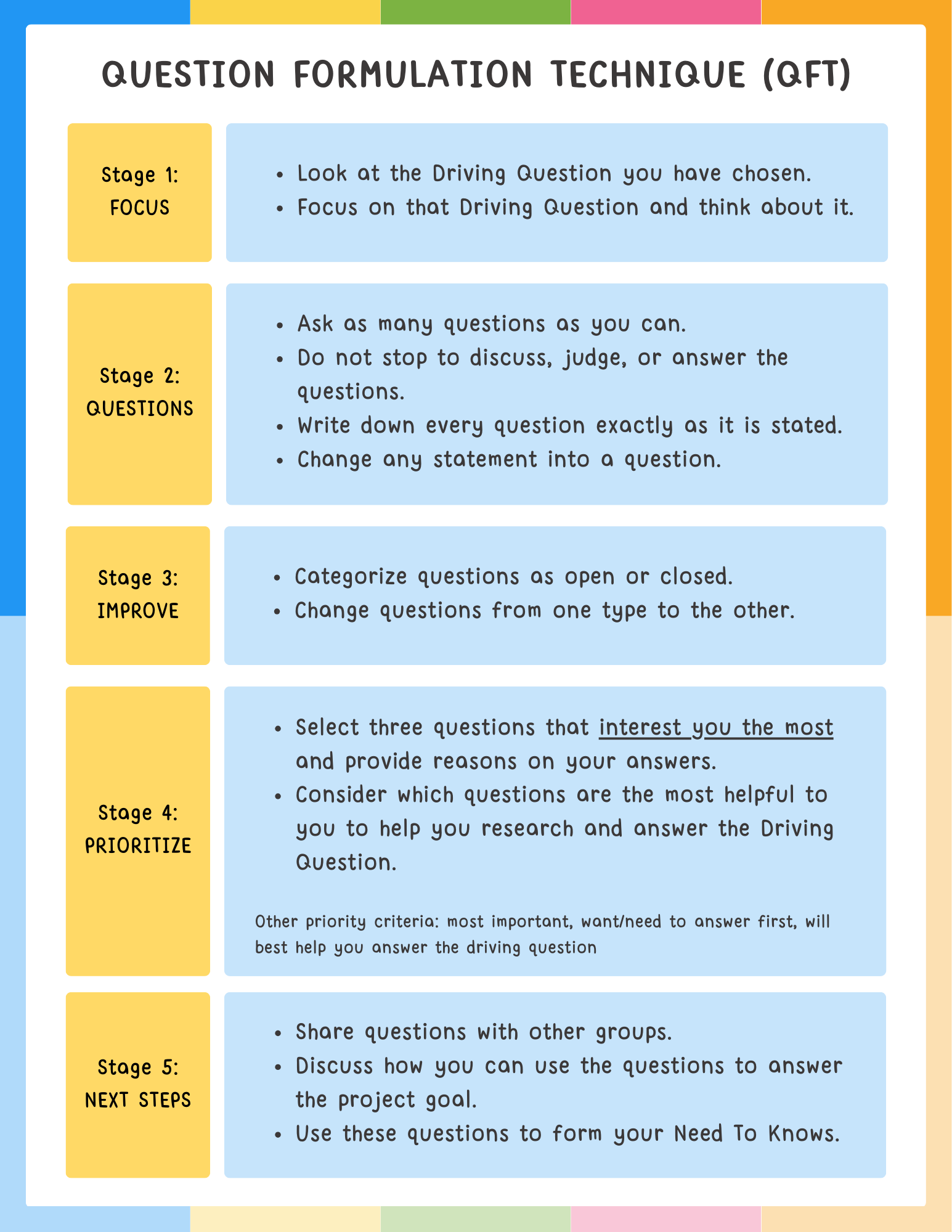
Now that you’ve chosen your question, think about your “Need To Knows.” These are the questions that you need answers to in order to help you answer your Driving Question. Follow the steps below to help you create and refine your questions.