Watch this video showing our solar system. While you are watching, write down the names of the celestial objects you see.

Solar System 101
A tour of our solar system and the celestial objects that make it up.
Solar System 101
A tour of our solar system and the celestial objects that make it up.
Video Transcript
Our solar system is one of over 500 known solar systems in the entire Milky Way galaxy.
The solar system came into being about 4.5 billion years ago when a cloud of interstellar gas and dust collapsed, resulting in a solar nebula, a swirling disk of material that collided to form the solar system.
The solar system is located in the Milky Way's Orion star cluster. Only 15% of stars in the galaxy host planetary systems, and one of those stars is our own sun.
Revolving around the sun are eight planets. The planets are divided into two categories based on their composition: terrestrial and Jovian.
Terrestrial planets, including Mercury, Venus, Earth, and Mars, are primarily made of rocky material. Their surfaces are solid, they don't have ring systems, they have very few or no moons, and they are relatively small.
The smallest and closest to the sun is Mercury, which has the shortest orbit in the solar system at about three Earth months.
Venus is the hottest planet, with temperatures of up to 867 degrees Fahrenheit, due to an atmosphere of carbon dioxide and extensive lava flows. Next to this world of fire is a world of water: Earth.
The water systems on this planet help create the only known environment in the universe capable of sustaining life.
The last of the terrestrial planets, Mars, might have also supported life about 3.7 billion years ago when the planet had a watery surface and moist atmosphere.
Beyond the four terrestrial planets of the inner solar system lie the Jovian planets of the outer solar system. The Jovian planets include gas giants Jupiter and Saturn, and ice giants Uranus and Neptune.
The gas giants are predominantly made of helium and hydrogen, and the ice giants also contain rock, ice, and a liquid mixture of water, methane, and ammonia.
All four Jovian planets have multiple moons, support ring systems, have no solid surface, and are immense.
The largest Jovian is also the largest planet in the solar system: Jupiter.
Nearby is Saturn, the solar system's second-largest planet. Its signature rings are wide enough to fit between Earth and the moon, but are barely a kilometer thick.
Past Saturn are the ice giants Uranus and Neptune. The slightly bigger of these ice giants, Uranus, is famous for rotating on its side.
Next to Uranus is Neptune, the outermost planet in the solar system and also one of the coldest.
Orbiting the terrestrial planets is the asteroid belt, a flat disk of rocky objects full of remnants from the solar system's formation, from microscopic dust particles to the largest known object, the dwarf planet Ceres.
Another disk of space debris lies much further out and orbits the Jovian planets: the icy Kuiper Belt.
Apart from asteroids, the Kuiper Belt is also home to dwarf planets such as Pluto and is the birthplace of many comets.
Beyond the Kuiper Belt is the Oort Cloud, a vast spherical collection of icy debris. It is considered the edge of the solar system since that is where the gravitational and physical influences of the sun end.
Our solar system's particular configuration of planets and other celestial objects, all revolving around a life-giving star, make it a special place to call home.
Driving Questions
Look at the three Driving Questions below and in your groups, decide which question you would like to answer. Each group can answer the same question or each group can answer different questions. The choice is yours!
- How can we create a model that shows the size and distances of the planets in the solar system?
- How can we design a travel guide for a journey to space?
- How can we create a news broadcast to share important space facts?
Possible Ideas
Scale Model Travel Brochure Space News
How can we create a model that shows the size and distances of the planets in the solar system?
Possible Idea: Solar System Scale Model
Activities:
- Research the relative sizes and distances between planets.
- Build a scale model using craft materials or digital tools.
- Label each planet with facts and key characteristics.
- Create a walking tour of the model on a playground or somewhere outdoors to demonstrate planetary distances.
How can we design a travel guide for a journey to space?
Possible Idea: Space Travel Brochure
Activities:
- Research what astronauts need for space travel and life in space.
- Design a brochure that promotes a space destination (e.g., the Moon, Mars).
- Include travel tips, activities, and interesting facts about the destination.
- Share brochures during a space-themed open house event.
How can we create a news broadcast to share important space facts?
Possible Idea: Space News
Activities:
- Research recent discoveries and exciting facts about space.
- Write news segments about planets, space travel, and future missions.
- Record a video broadcast or perform it live for an audience.
- Share the video broadcast on a school website or class blog.
Thinking Time
What will your group do or make to answer your Driving Question? Use the space below to draw some ideas with your group. Remember to download or save your picture for future use!
Need To Knows
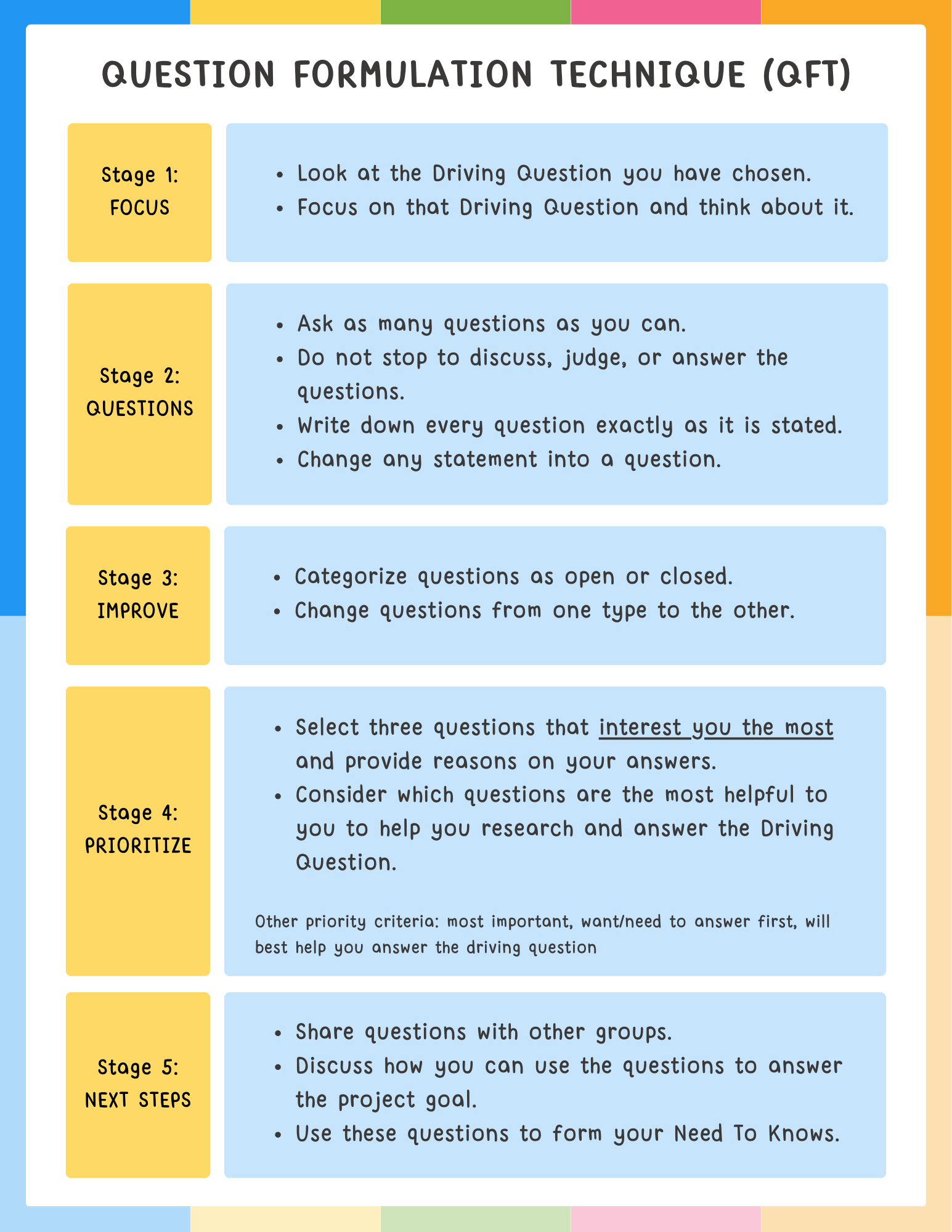
Now that you’ve chosen your question, think about your “Need To Knows.” These are the questions that you need answers to in order to help you answer your Driving Question. Follow the steps below to help you create and refine your questions.
-------------------------------------------------------------------------------------------
Old Project Question
For classes using the old unit project, PBL can be integrated with the following Driving Question:
How can we design a home on another planet that people would want to live in?